While most people associate the Sealed Knot with massed battles, we also spend a lot of time looking into and reenacting the lives of ordinary people from the 17th Century.
Our living history encampments are an ideal opportunity to practice traditional crafts such as sewing, weaving, leather-working, woodturning and many more, jobs that weren’t necessarily associated with the war effort but which formed vital parts of everyday life. This gives us the chance to connect with the past in small, intimate ways which reveal something of the real lives we hope to bring to life once more.
We’ll be featuring some of our members and the trades or skills they take part in at events, with some of the historical context behind them. In this first post, we meet Julian, who is a joiner and carpenter in real life, but who swaps his power drill for traditional woodworking skills…
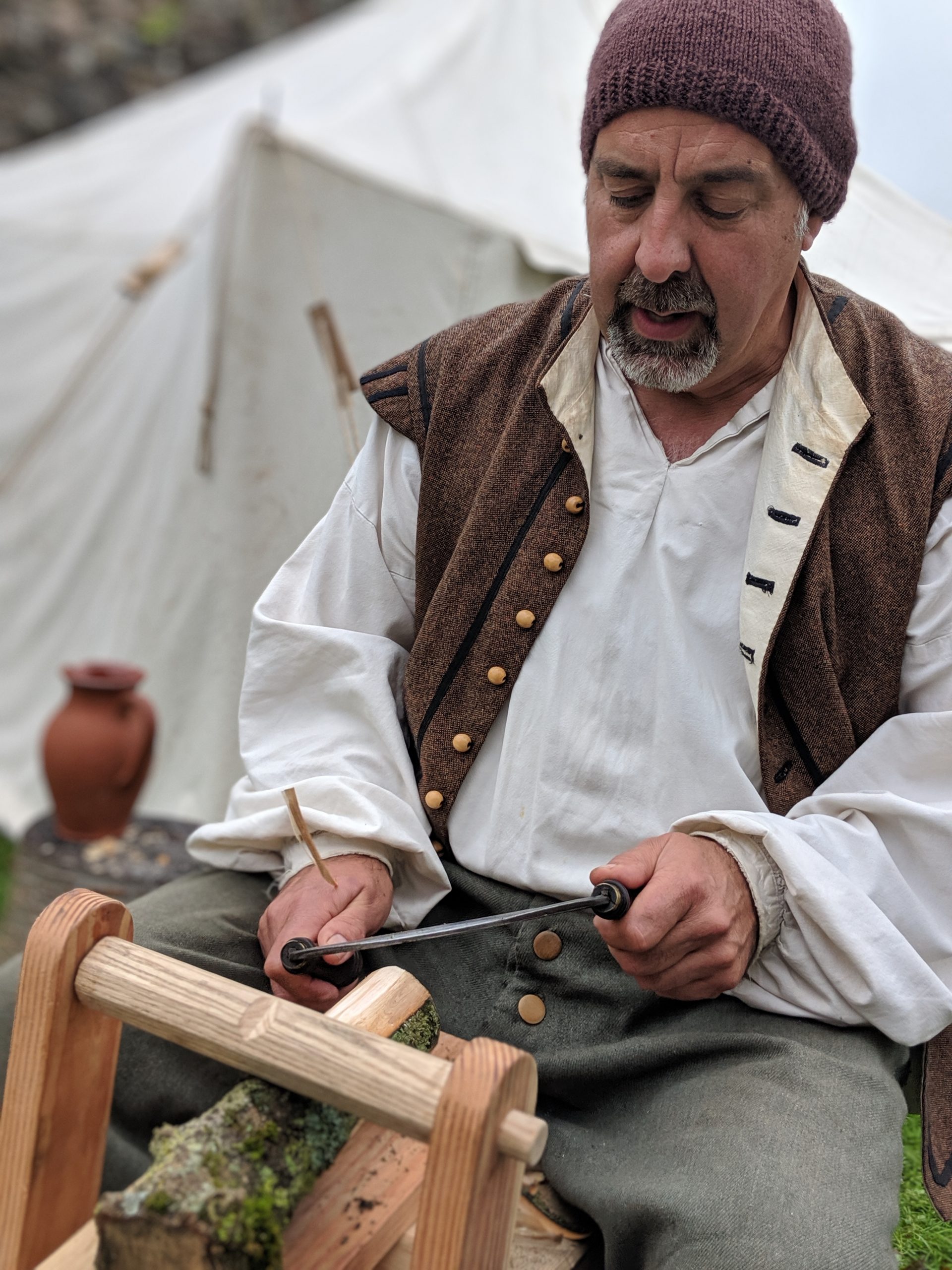 Julian sits at his ‘holdfast’, a bench with foot-operated canterlever that keeps a piece of wood he is working on fixed firmly in place.
He is using a ‘drawknife’ to slice the wood into a rough shape, before using finer tools to whittle the wood into its final form. In this case, he is fashioning simple spoons for the soldiers on the camp.
A typical woodworker in the early 17th Century spent seven years apprenticed to a master craftsman to learn his trade. This was the period where joinery, carpentry, and artisanal carving began to become specialised skills. A list from 1630 gives wages for tradesmen, including woodworkers, in the New England colony of Massachusetts Bay: “28 Septembr 1630: …that noe maister carpenter, mason, joyner, or brickelayer shall take above 16d a day for their worke, if they have meate and drinke, & the second sort not above 12d aday, under payne of xs both to giver & receaver”.
Standards of living in London during the late 1640s represented the worst economic slump since the 1590s and the London turner Nehemiah Wallington lamented that “workmen are gone and trading is dead”, while the Venetian ambassador wrote that “all shops are kept shut by order of Parliament with loss to merchants and inconvenience to the inhabitants”.
While English carpentry was still highly prized, London’s woodworkers and carvers were particularly sensitive to the ‘aliens’ in their midst – skilled artisans from Europe and further afield – and their guild attempted, unsuccessfully, to maintain their members’ protected status while absorbing these interlopers’ fashionable foreign styles.
However, despite the hostility it was these foreign artisans who helped sparked the birth of modern English furniture. With the Restoration of the monarchy in 1660, there was an influx of continental craftsmen into London, catering both for the refurbishment of the Royal palaces and the resultant consumer hunger for fashionable new furniture. This economic boom saw London become one of the European centres of woodworking and furniture making.
However, outside the capital and away from these fasionable trades, most carpenters’ lives continued to be dominated by making objects for everyday use, from roof joists to cutlery, from wheels to stools.
 Bibliography
Paul S. Seaver, Wallington’s World: A Puritan Artisan in Seventeenth-Century London (Stanford University Press, 1998)