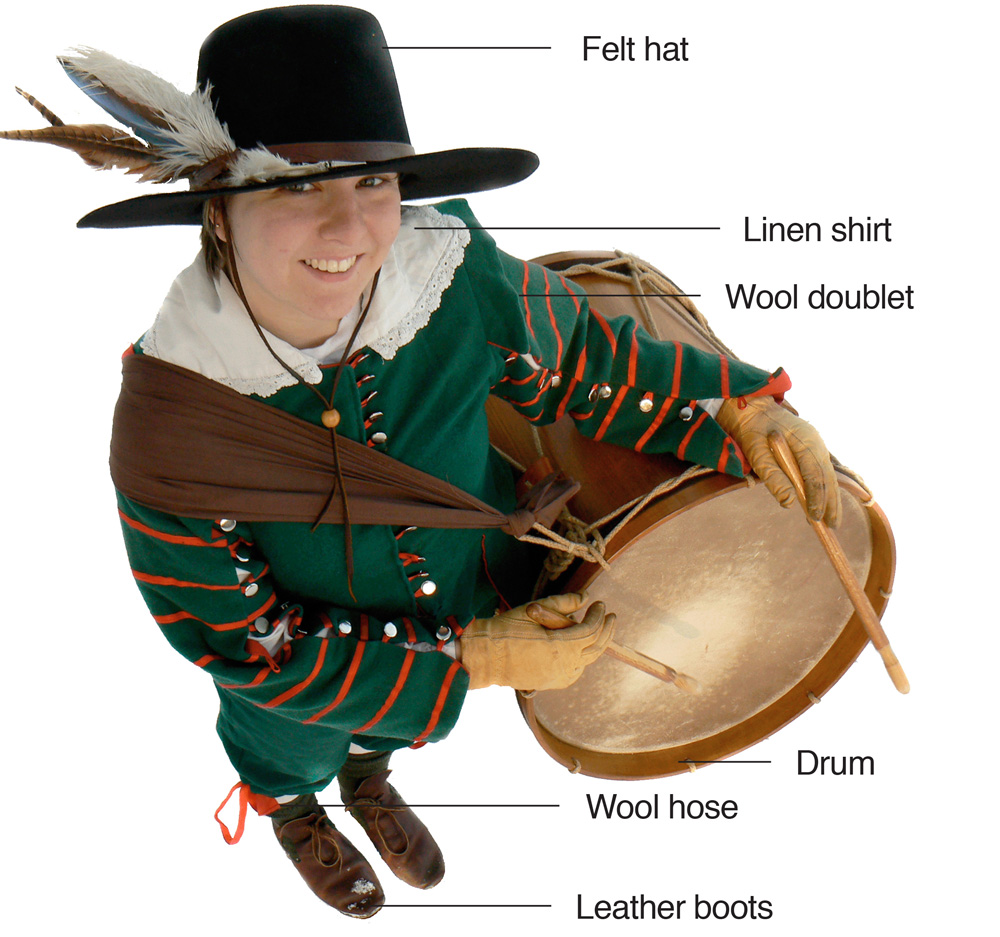
The sound of war drums can be an incredibly stirring experience, which creates atmosphere on the battlefield and produces a real spectacle for the public.
Manchester’s has a very experienced and well-respected band of drummers. You don’t have to be musical to drum and our drummers are always keen to show new people the ropes.
If you want to take part in the battle but don’t want to fight then being a drummer is ideal – it allows you to be in the thick of the action without having to engage with the enemy.

Being a Drummer
Drummers are the heart and soul of the regiment – they keep up our morale, help us march to and from the battlefield, and sound out orders on the field.
They are officially “non-combatants”, which means they do not fight. But they must stay alert and eagle-eyed to ensure they remain with the regiment and can head for the safety of the pike block if threatened by enemy cavalry.
Drummers use their own drums – up to 22” in diameter, with skins of goat or calf skin, and a wooden frame. New drummers can usually borrow a drum to start with. There are wide range of tunes, some are historically accurate while others are modern ones developed for the peculiarities of reenactment. You don’t have to be musical, just willing to learn the beats and to practice.
Our drummers are always keen to show new people the ropes; the tunes are easy to pick up and you’ll have pride of place as the “voice” of the regiment!
The kit you’ll need to get started
In your first season, the regiment will be able to lend you your uniform of red soldier’s coat, breeches, and woollen stockings to make sure you’re not shelling out on kit before you’ve had a go.
You will need is a sturdy pair of boots of boots – preferably brown and without steel toecaps and obvious trademarks. Depending on your shoe size a member of the regiment may have spare authentic footwear that they can lend you for a muster.
We will lend you a drum for your first season and, if you enjoy it, second hand ones can be easily picked up for a reasonable price.
FAQ
Do I have to buy my own drum straight away?
No, we have spare drums that you can use for your first season.
Is being on the battlefield dangerous?
The great thing about being a drummer is that you can be in the thick of it but not have to take part in the battle itself. The drums are the ideal role for someone who wants to get involved but doesn’t want to fight.
The History of the Drums
The idea of a ‘drummer boy’ is a relatively modern one – 17th Century drummers would have been experienced, educated soldies and were a vital part of a 17th Century army. Battles are noisy and communicating orders to large groups of men using voices alone isn’t feasible. The drums signalled a commander’s orders to his troops using different drum beats – in many respects they were the ‘walkie-talkies’ of the era. They also helped intimidate the enemy and stir troops into action.
Drummers were reliable, steady men who carried wooden drums 20 and 22” in diameter, striking a drumhead of calf or goat skin. Drums were stationed with the divisions of pike, with usually two drummers per company.
They would sometimes be used to carry messages to the enemy in a “parlay”, whereupon they would be expected to spy on the enemy’s camp while doing so. It was considered very bad form to kill a drummer beating a parlay, though there were occasions when drummers met grisly ends when the enemy offered “no quarter”.