Siege warfare in the English Civil Wars
“If you lay siege to a town, you will exhaust your strength.” – Sun Tzu
Contrary to popular notions of set piece clashes filled with dashing cavalry charges and tens of thousands of soldiers, sieges were “every bit as important as battle in the Civil Wars … holding cities dominated trade, allowed regulation of taxation, and controlled major ways – thus shaping campaigns.” [1] In a country that had undergone one of its longest periods of internal peace, the town defences were generally in poor condition and, where they existed, tended to be medieval in origin. Coastal towns such as Hull, Bristol, Liverpool, and Plymouth had strong defences to repel potential foreign invaders, but inland areas were still dominated by castles such as Basing House, Pontefract, Skipton, and Carlisle.
While modern earthworks and trenches could be thrown up to create or augment a town’s defences, these medieval castles required “an experienced engineer … together with a good train of heavy siege guns” [2] to overcome and, despite the increasing size and power of smooth-bore cannon, they presented a major problem for both sides as, as their original builders intended, they often provided control over large areas or key roads, such as Basing House which commanded the western road from London to Salisbury, and Pontefract Castle and Newark, which sat on the main road north from London to Edinburgh.
Why besiege at all? The reason is that garrisons proved very effective tools of disruption for both sides – from the nominally-Parliamentarian ‘Tinker Fox’ whose notorious garrison operated out of Edgbaston House in Warwickshire to Royalist Sir Gervase Lucas’s flying column that used Belvoir Castle in Leicestershire to raid Parliament’s borders and supply chains. Leaving a garrison unmolested could also allow an enemy army to grow in the heart of your territory, tying up resources and leaving you exposed.

Artist’s impression of the siege of Basing House, 1643
At the beginning of the civil wars, there were few experienced siege engineers – most Englishmen with professional experience of war on the Continent had served in the infantry – and so both sides had to employ foreign engineers, but this still only amounted to a handful of mostly Dutch or Germans. When the King’s nephew, Prince Rupert of the Rhine, came to aid his uncle’s war effort in 1642, he brought with him a number of expert engineers and gunners, including the Walloon Sir Bernard de Gomme (who was responsible for the siege and re-fortification of Bristol in 1643), the gunner Bartholomew de la Roche, and the Swedish engineer Beckmann, who dealt with fortifying the royal capital at Oxford. Parliament too relied on foreign specialists in the “black ways” of fortress warfare, such as “the hard-drinking Dutchman John Dalbier”, who directed the sieges of Basing House and Donnington Castle, and later the New Model Army relied on the services of Peter Manteau van Dalem. [3]
Both sides possessed their own ‘siege trains’ of varying sizes – slow-moving convoys of cannons, their crews, impressed ‘pioneers’, and siege experts that would travel separately to the main army and would be called upon to lay siege to an enemy fortification while the larger force moved on. These trains could include a wide variety of different guns, from ‘cannon royal’ to ‘culverins’, 63-15 pounders, and mortars of various sizes.
However, as strong as they were their targets were no less formidable.While medieval castles may have seemed antiquated in comparison to the newer style of fortifications developed by the Dutch and Germans, they proved remarkably resilient and stubborn during the English Civil Wars. The garrison of Pontefract Castle, under the command of Sir Richard Lowther, modified the castle to resist artillery by building up earth banks to bolster stone walls, and converting its ancient motte to fire guns. The pounding that castles could take is demonstrated by the diary of Nathan Drake, composed during the first siege of Pontefract, who recorded no fewer than 1,406 artillery rounds were fired at the castle between Christmas and 28 January 1645, from four guns between 42 pounds gun and 9 pounds: “The five days from 17 to 23 January were especially punishing, 400, 348, 282, 144 and 189 ‘great shot’ being fired on each day respectively. This impressive cannonade would seem to prove that Civil War gunnery was slow only by modern standards, and that when circumstances demanded, and materials allowed, bombardments could be both intense and highly destructive.” [4]
Sieges could be a costly business, both in terms of resources and manpower. In his 1671 treatise Observations, George Monk – who had fought on both sides in the English Civil War – wrote “Every Commander knows that mans flesh is the best fortification that belongs to a Town; and where a Town is well manned, the best way of taking it is by Starving; and when a town is weakly manned, the best of taking it is by Battery and Assaults, or by Approaches, Mining, Battery, and Assaults”. So commanders were forced to decide whether it was worth storming a town or castle, or waiting it out and starving the enemy into submission.
An assault could be extremely costly – after he had tried to take Basing House by direct assault three times in November 1643, Parliamentarian general Sir William Waller decided his troops lacked the necessary resolve and withdrew, leaving hundreds dead, and during the bitter siege of Clonmel in Ireland in 1650, Oliver Cromwell lost around 2,000 soldiers from a single attack, the New Model Army’s largest ever loss in a single day.
Many commanders would decide to settle in to test the resolve of their enemy and wait to force a garrison’s capitulation as supplies of food and ammunition ran low, rather than face the risks of assaulting heavily-defended positions. The siege of Colchester in 1648 was a particularly horrific example of a drawn-out siege, where the townspeople were forced to eat pets and rats as the Royalist garrison refused to surrender to Sir Thomas Fairfax’s forces. However, such long sieges also left the besieging force vulnerable – the besiegers of Pontefract Castle in 1645 were defeated by a Royalist relief force of cavalry led by Sir Marmaduke Langdale, which had had the time to march all the way from Oxford. With only temporary or poorly-constructed lodgings, the besiegers were also vulnerable to diseases such as typhus, known as ‘camp fever’, which could easily cause as many losses as a direct assault; the Parliamentarians besieging Basing House in 1644 were decimated by disease and forced to withdraw.
The most effective method of besieging a castle or town was simply to cut it off from the outside world, thereby starving its inhabitants. This could be done by creating ‘lines of circumvallation’, a system of earthworks, trenches, and small forts that would prevent both the enemy “sallying” out of the castle and any relief force from reaching them. These would be built by teams of ‘pioneers’, which would often by conscripted men or criminals forced to build defences – many soldiers considered the status of full-time pioneer “the ultimate degradation”, but would be offered a bonus at a going rate of one shilling a day. Often, townspeople would be pressed into the engineering works – in the first civil war, the population of Oxford deeply resented being made to dig earthworks around their city and the Royalists were often exasperated at their lack of enthusiasm for the project. Encircling took time, however, and garrisons were rarely passive – the defenders of Pontefract Castle would fire their cannons at their besiegers’ trenches and forts, causing significant casualties, and often sent out raiding parties to collect food, drive off workmen, destroy newly-built gun platforms, or simply to harass already stressed and vulnerable soldiers.
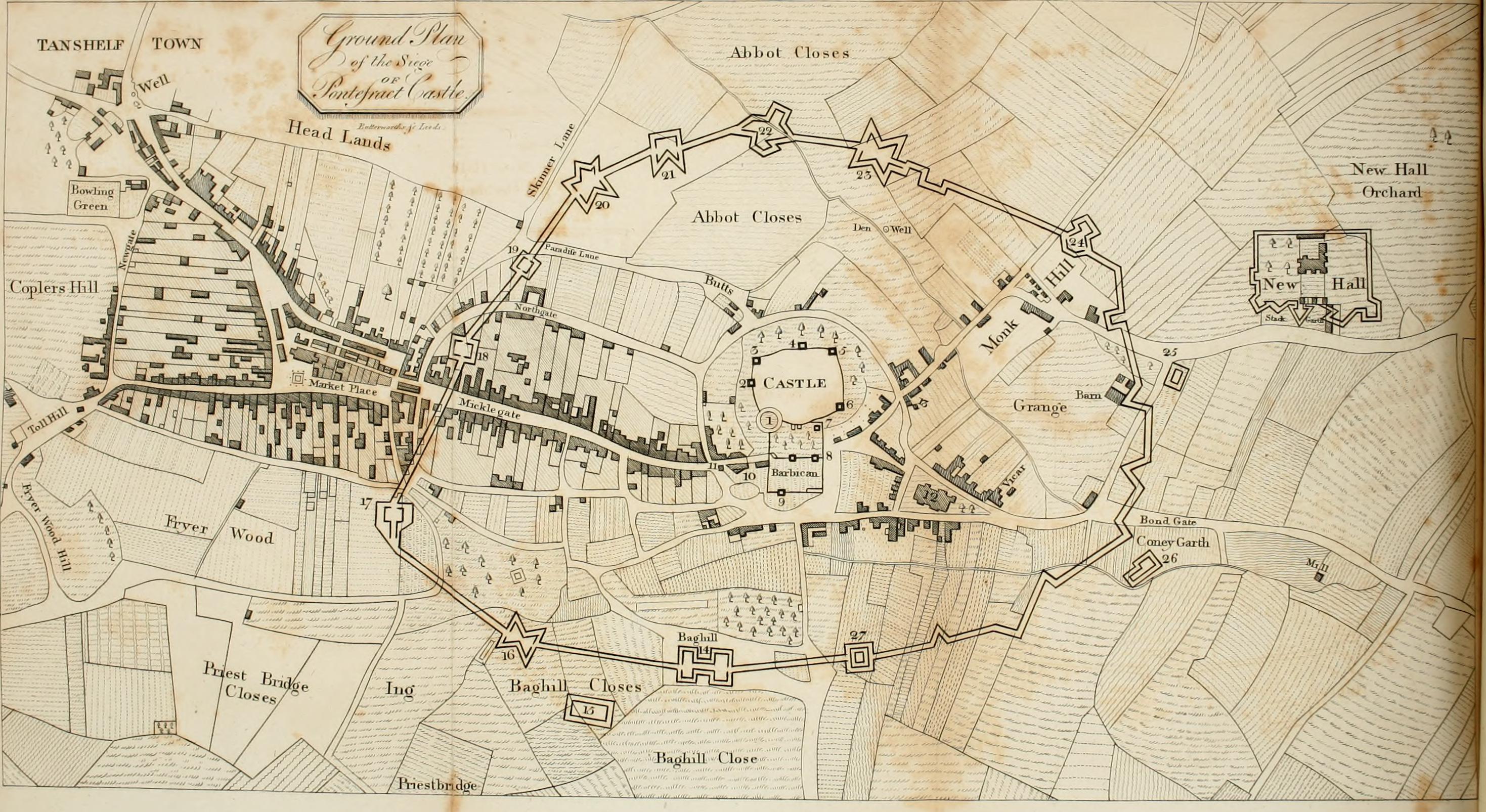
The siege lines drawn around Pontefract Castle in the second siege of 1645
Sieges happened underground as well as on the surface and on this subject the English needed no foreign instruction: “for some time now the more adventurous English and Scots miners had gone off to serve in the French armies, and when war broke out in Britain the mineral miners of the Mendips and Derbyshire and the colliers of Staffordshire and Scotland adapted themselves readily to the demands of military mining.” [5] ‘Undermining’ had been employed in sieges for centuries and involved digging under a castle’s walls and then either setting fire to the wooden beams holding up the tunnel, thereby causing the ground to give way and the walls to fall, or packing a tunnel with gunpowder and blowing it up. During the many months of the siege of Pontefract Castle numerous mines were dug through solid rock from the Parliamentarian siege lines, though the garrison was not helpless while this happened – the Royalists dug ‘counter mines’ from which the enemy could be intercepted, or blown up by smaller charges. This may have been helped by the experience of the garrison’s commander, Colonel Richard Lowther, who had operated a colliery in Northumberland before the war. As detailed in the diary of one of the defenders, Nathan Drake: “After that the enemy was weary with bursting their Gunnes with Battery of the castle upwards towards heaven & see that they could not prevail that way, then they came to be partners with Guydo Faulkes to dive downwards to the Devil, to undermine us and to blow us up by their several mines … one mine was below Wardes house under the moat of the Castle towards the Round tower, another within the hospital towards the King’s Tower; making their boasts that they would bestow 100 barrels of powder upon us to blow us up, but, we perceiving their intentions, we answered them at their own weapons and mined as fast as they, sinking in several places within the castle and mining from thence and also without the Castle walls near to the Castle … We sunk 11 or 12 pits in several places from whence we mined under the castle walls that we could have mined from one place to another round about the castle if need had required, and so have prevented all their plots.”
Of course, as Monk pointed out, while walls may withstand a cannonade it is not guaranteed that the resolve of either besieger or besieged will hold firm – while there are many examples of garrisons holding out against much greater enemies, many simply gave up after a simple show of force or first assault. Often, an attacking army would give the defenders a choice – surrender now or expect ‘no quarter’ if they resisted. ‘Quarter’ was, in essence, ‘mercy’ and the offer would be intended to dissuade defenders from holding out against impossible odds. However, this meant that should a garrison hold out but later surrender or be taken, those inside could expect little mercy – in the aftermath of the notorious siege of Hopton Castle in 1644, the common soldiers amongst the defenders reputedly had their throats slit before being dumped in the castle’s moat and ‘Hopton Quarter’ became a byword for treacherous treatment by your opponents. However, a stubborn garrison such as Pontefract might successfully negotiate with their weary opponents, being allowed to withdraw with their honours and weapons intact; in this case, Colonel Lowther’s men were even allowed to then join the Royalist garrison at Newark.
Sieges were a dirty business in the English Civil Wars: besiegers and besieged alike faced a daily threat from bombardment, sniper fire, disease, starvation, or even just plain boredom before the intensity of an assault. Yet the effect sieges had on the wider conflict is often overlooked – they soaked up resources and held up armies while resolute defence could provide a much-needed morale boost for a cause.
_____________________________
Footnotes:
[1] [4] Stephen Bull, The Furie of the Ordnance: Artillery in the English Civil Wars (2008)
[2] Keith Roberts, Cromwell’s War Machine (2005)
[3] [5] Christopher Duffy, Siege Warfare: The Fortress in the Early Modern World 1494-1660 (1997)
Bibliography
History of Parliament Online: Pontefract
John Barratt, ‘A Rabble of Gentility’: The Royalist Northern Horse, 1644-45 (2017)
Mike Osborne, Sieges and Fortifications of the Civil Wars in Britain (2004)
David Cooke, Yorkshire Sieges of the Civil Wars (2011)
Stephen Bull, The Furie of the Ordnance: Artillery in the English Civil Wars (2008)
Lila Rakoczy, Archaeology of Destruction: A Reinterpretation of castle slightings in the English Civil War (2007)
Keith Roberts, Cromwell’s War Machine (2005)
Christopher Duffy, Siege Warfare: The Fortress in the Early Modern World 1494-1660 (1997)