

A portrait believed to be of William Dowsing, on show at Christchurch Mansion in Ipswich.
On the cold morning of 21st December 1643, a group of men marched into the ornate chapel of Peterhouse, the oldest university college in Cambridge.
In the presence of the college’s president, fellows and other dignitaries, they began to smash, pull down, and deface religious imagery on the walls and pews. Statues of two large winged angels and four saints were brought down, stained glass was smashed, an image of St Peter on the chapel door was removed along with those of about a hundred cherubim and angels, while bible passages illuminated in gold letters were erased.
But this was not sudden mob violence or a secular attack on the church. It was an official and systematic purging of ‘idolatry’ in one of the key centres of Christian study in England.
And watching over all of it was a man called William Dowsing.
From late 1643 to 1644, armed with a commission from the Parliamentarian general and Peer, the Earl of Manchester, this previously-unknown yeoman farmer visited some 250 university colleges and parish churches in Cambridgeshire and Suffolk, stripping them of religious pictures, crosses, crucifixes, stained glass, monumental brasses, and altar rails – anything that could be construed as encouraging Roman Catholicism, ’religious idolatry’, or the worship of physical objects.
Even hundreds of years later, Dowsing’s name is still said with bitterness in the villages and towns he visited. His whirlwind of destruction – sometimes intensive but at other times directionless or lax – across the southern half of East Anglia has come to represent a destructive, iconoclastic moment in British history. He is remembered now not just because of the damage he wrought but also thanks to the journal he left behind – a detailed, itemised listing of his journeys and the work he and his men carried out. It is as unique as the man who wrote it.
Born in the village of Laxfield in Suffolk in around 1596 to a respectable yeomen family, Dowsing was, for most of his life, a farmer with significant amounts of land across four parishes. His father was Woulferyn Dowsing of Laxfield, and his mother Joane, the eldest daughter of Symond Cooke of Laxfield, and besides Laxfield he also lived at the villages of Coddenham, Eye, and Stratford St. Mary, all of which he would come to visit in his ‘professional’ capacity. Some time in the early 1620s, Dowsing married Thamar Lea, the daughter of a ‘godly’ (i.e. staunchly Puritan) Suffolk gentleman, and moved to a farmhouse just outside of Thamar’s home village of Coddenham, where they had ten children. Thamar died suddenly in 1640, leaving Dowsing to support a large household and by 1641 he had moved to Stratford St. Mary in the Stour Valley, a region known for Puritan sympathies. It is clear Dowsing and his family – like many in this Puritan heartland – were not supporters of King Charles and his religious policies. In January 1634 the bailiffs of Eye reported one “William Dowsing, gent., an inhabitant” refused to take in an apprentice as directed in King Charles’ The Book of Orders1 and when civil war broke out, his eldest brother, Simon, is mentioned as lending £10 “for the defence of the parliament”. More importantly, considering his future career, a petition to the House of Commons presented on 20 January 1642, which bemoaned “a great stopp of reformation in matter of religion” and a threat from “papists and other ill-affected persons”, bears his signature.
We know that Dowsing was a devout Puritan and an educated one, though it’s unlikely he went to university. This did not stop him amassing a serious library, including extensive collections of sermons given to Parliament on official days of fasting, his plentiful annotations suggesting he already had a keen interest in images and idolatry.
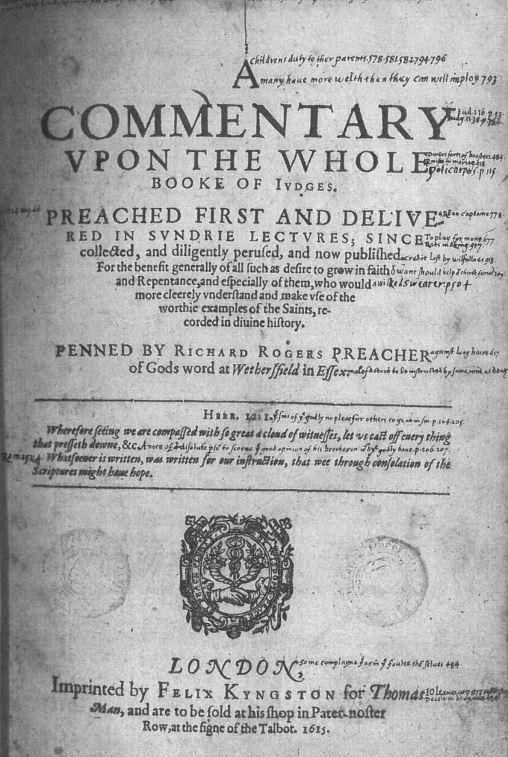
A recent discovery of Richard Rogers’ Commentary upon the Whole Book of Judges (1615) extensively indexed and annotated by Dowsing, who spent two hours a night over two months reading and indexing Rogers’ book – 16 pages every evening.
This, along with the influence of local Puritan preachers such as Matthias Candler and Thomas Waterhouse, and his close friendship with the popular preacher and writer Matthew Newcomen in nearby Dedham parish, show how Dowsing’s faith inspired his radicalism. By March 1643, he was already keen to see the chapels and churches of Cambridge and its university ‘purged’, as a letter to Newcomen demonstrates:
if you have anie interest in parliament men, now we have an army at Cambridge it might be a fitt time to write to ye Vice Chancellor of Cambridge & Mayor to pull down all ther blasphemous crucifixes, all superstitious pictures and reliques of popery according to the ordinances o’ parliament. I refere you to yt famous story Ed[ward VI’s reign] how the English got victory against the Scots in Museleborough field the same day … the Reformation was rough in London and images burnt.
It may be that this letter unwittingly acted as a job application…
Parliament had been at war with King Charles since the previous August, but even before then there had been a sustained effort to purge churches of both any remnants of medieval Catholicism and the recent reforms of the much-hated Archbishop of Canterbury, William Laud. Parliament’s first attempt to remove “innovations in or about the worship of God” in hopes of restoring “the public peace” came in an ordinance passed in September 1641. “Few parliamentary injunctions were to have a greater, or more disruptive, impact of the life of England’s parishes,” wrote John Adamson in The Noble Revolt, “which was to unleash an outbreak of image-smashing and altar-breaking on a scale probably not seen since the reign of Edward VI.” A further ordinance in 28 August 1643 intended to continue and broaden the purge, ordering the destruction of fixed alters, alter rails, chancel steps. crucifix crosses, images of the Virgin Mary, and pictures of saints or superstitious inscriptions.
In early 1643 Dowsing had been appointed provost-marshal (a kind of military policeman) for the army of the Eastern Association, the civil and military administration overseeing the Parliamentary-controlled counties of Essex, Hertfordshire, Norfolk, Suffolk, and Cambridgeshire, Huntingdonshire and Lincolnshire. The association’s ineffectiual commander, William Grey 1st Baron Grey of Werke, was replaced by Edward Montagu, the second Earl of Manchester, in August of that year.
Manchester was a Puritan nobleman, one of the ‘junto’ of peers who resisted the King in years before the war, and the only member of the House of Lords to be named alongside the ‘Five Members’ who Charles had tried to arrest in January 1642. He was also proactive in having “malignant” preachers ejected from their positions, beginning with the colleages of Cambridge University and then across the counties of the Association.
By winter, it had been brought to his notice that Parliament’s ordinances about church decoration were not being obeyed properly and most parishes remained unmolested. While there had been some work done, carried out by earnest locals or soldiers, it was broadly unwelcome – even amongst fellow Puritans. In December 1643, Norfolk Puritan Thomas Windham called such would-be iconoclasm “odious” and warned that the “fury” towards churches of those carrying it was “detestable”. “Such indifference to the behests of Parliament,” wrote Robert Wyndham Ketton-Cremer in Norfolk in the Civil War, “could not be allowed to continue”.
On 19 December 1643, possibly because his letter to Newcomen had been passed along, Dowsing received a remarkable document from the Earl – a commission to enforce the 1643 ordinance:
Whereas by an Ordinance of the Lords and Com’ons assembled in Parliam’t beareinge date the 28th day of August last it is amongust other thinges ordained th’t all Crucifixes Crosses & all Images of any one or more p’sons of the Trenity or of the Virgin Marye & all other Images & pictures of Saints & supersticious inscriptions in or upon all & every the s’d Churches or Cappeles or other place of publique prayer Churchyards or other places to any the s’d Churches or Chapells or other place of publique praier belonginge / or in any other open place shoulde before November last be taken away & defaced as by the s’d Ordinance more at large appeareth And whereas many such Crosses Crucifixes & other supersticious images & pictures are still continued within the Associated Counties in manifest Contempt of the s’d Ordinance. These are therefore to Will & require you forthw’th to make your repaier to the severall Associated Counties and put the s’d Ordinance in execution in every p[ar]ticular hereby requiring all Mayors Sheriffes, Bayliffes Constables headburoughs &all other his Ma[jest]ties Officers & loveinge subiects to be ayding & assisting unto you whereof they may not faile at there perills. Given under my hand & seale this 19 of December 1643.
[Signed] Manchester
To Will’m Dowsinge gen. & to such as hee shall appoint.
On 21 December, Dowsing began his work.
The vicar of Kesgrave, which he visited on 27 January, described Dowsing as a grim person dressed in sombre clothes “with a tall hat”. Armed with his warrant from the Earl, he began his campaign at Peterhouse College in Cambridge, a well-known centre of Arminianism2. As a firm supporter of Laud, its master, John Cosin, had made significant changes to the chapel to bring it into line with Laud’s idea of the “beauty of holiness”. By the time Dowsing appeared at the doors, Cosin had already been expelled from his position by Parliamentary ordinance. Dowsing and his men were there to finish the job.
At Pembroke Hall on December 26 1643 he met his first opposition. As they prepared to smash ten angels and pull down eighty “superstitious pictures”, the members of the college objected and what transpired was a debate in which Dowsing showed the temper of the times – misquoting scripture and twisting theology to suit his agenda: “Mr. Weeden told me, he could fetch a Statute Booke to shew, that pictures were not to be pulled down; I bad him fetch and shew it and they should stand; and he and Mr. Boldero told me, the clargie had only to doe in ecclesiastical matters, neither the Magistrate, nor the Parliament had any thing to doe.” It may have been because of Weedon’s challenge to Dowsing’s authority, that Dowsing wrote to Manchester seeking confirmation of his powers – this resulted in a second commission explicitly stating that anyone standing in Dowsing’s way should be dragged before the Earl, as Dowsing ordered to happen to churchwarden John Pain at Great Cornard in Suffolk on 20 February 1643, for refusing to pay for Dowsing’s ‘services’ and not abiding by the terms of the ordinance.
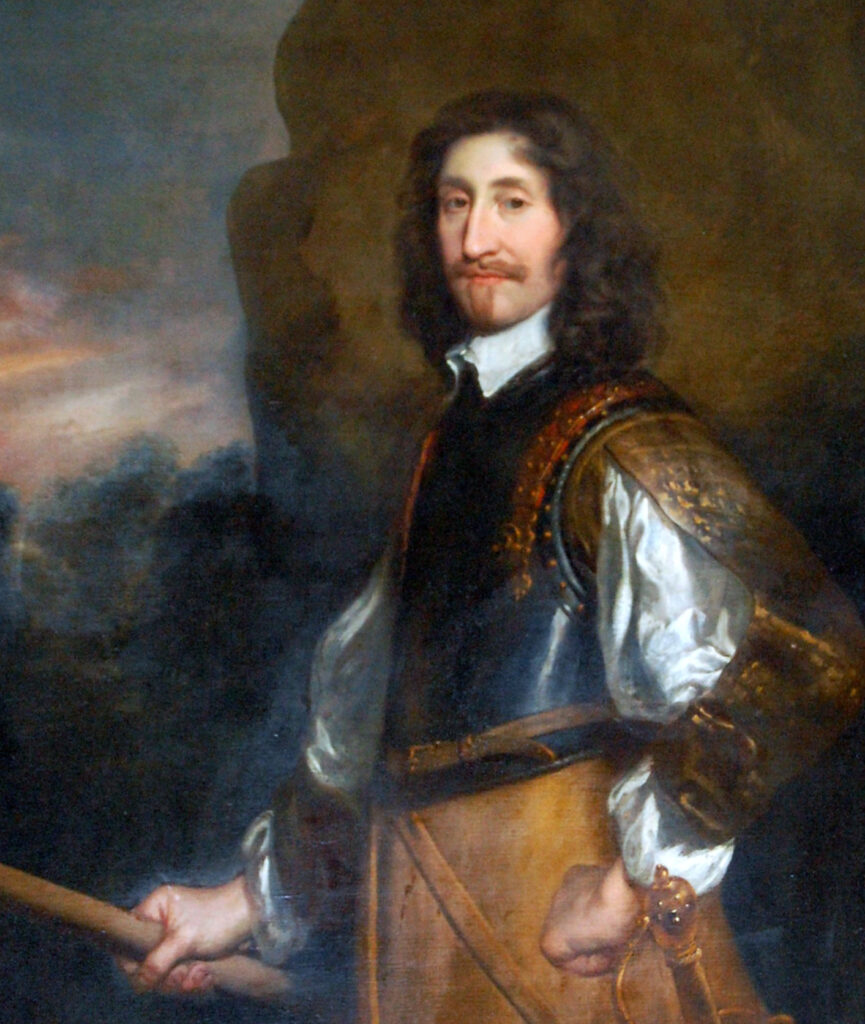
The Earl of Manchester in a portrait displayed in Kimbolton School, the former seat of the Montagus in Huntingdonshire
It is no exaggeration to describe Dowsing’s commission as unique. It is unclear why Manchester instigated such a radical programme of work – he did not technically hold such power and no other Parliamentarian commander ever issued such commissions. Yet Manchester was a devout Presbyterian, had been an advocate in the House of Lords for the 1641 ordinance, would be heavily involved in efforts to suppress “scandalous” ministers in the region, and – following an ordinance of January 1644 – expelled supporters of the King or Archbishop William Laud from Cambridge University. In this context, it is clear that the earl saw his role as a military, legal, and religious one.
In reality, Manchester’s commission to Dowsing held no legal weight as the August 1643 ordinance had ordered local churchwardens to carry out such work, not commissioners or soldiers. Yet Dowsing’s commission was indicative of the ‘militant Puritanism’ and ‘fever pitch of anti-papist sentiment’ that existed in the Eastern Association — for Manchester and Dowsing, this was less a matter of enforcing the law than it was part of a divinely-appointed mission.
Within a fortnight, Dowsing had visited all of Cambridge’s colleges and parish churches and struck out into Cambridgeshire. Sometimes accompanied by a deputy and sometimes by soldiers, Dowsing would make an inventory of all objects of idolatry and superstition in each church, then destroy what he could, and leave orders for the destruction of the rest. Sometimes churchwardens and clergy of parish churches assisted him, but at other times he met with open resistance or non-cooperation. At Great Cornard, the churchwarden John Pain bravely refused to pay the fee Dowsing demanded for this work and was hauled away by the constable to answer to Manchester in person.
When Dowsing travelled into Suffolk in January 1643, the sheer number of churches required him to appoint deputies to carry out the work – these were often family and friends. Each church was charged one noble (a third of a pound) for his or his deputies’ services, removing stained glass windows, toppling crosses from roofs, defacing statues, removing brasses plaques, chiselling off symbols on walls and fonts, and demanding that steps leading up to altars be lowered. This delegation of duties seems to have spread across the Association, with the Norfolk village of Bressingham paying six shillings to one Captain Gilley “for the viewing the church, for abolishing superstitious pictures” and three shillings and fourpence to John Nunn for two days’ work taking down glass and pictures, and filing inscriptions off the bells.
Not even the church at Laxfield, Dowsing’s birthplace, escaped such treatment. Considering that some of the items he ordered removed on 17 July 1644 remain to this day suggests that his arrival was not always welcome and promises to complete work less than sincere.
By 9 January he was in Sudbury, where he dealt with just three churches but on 22 January he set off with renewed vigour, and over the next six days he visited twenty churches through his old home parish of Coddenham all the way to the coast at Aldburgh. The return journey home took him via Ufford, east of Ipswich, one of the more troublesome parishes, where:
We brake down 30 superstitious pictures; and gave direction to take down 37 more; and 40 cherubims to be takeing down of wood; and the chancel levelled. There was a picture of Christ on the cross, and God the Father above it; and left 37 superstitious pictures to be taken down; and took up 6 superstitious inscriptions in brass.
When he returned to Ufford the following August, Dowsing not only found most of the work left undone but encountered churchwardens and even the local constable who stubbornly refused to give him the keys to the church for two hours.
He then dealt with Ipswich before having one of his busiest periods – six weeks during which he typically covered five or six churches a day. By the end of March, he had worked his way through almost every church in the south of the county and so headed back into Suffolk. But by July the work had virtually ground to a halt — Dowsing had visited more than two hundred churches in the four months after receiving his commission but this slowed to a trickle and, more than likely, focused on parishes which had failed to comply with previous orders from him or his deputies. His journal peters out with merely three entries in September and October, all within striking distance of his old home in Laxfield.
His final journal entry is dated 1 October, marking the end of a ten-month journey. The reason his work ceased is no mystery – later that month his patron, the Earl of Manchester, became engulfed in a controversy that would not only change the Parliamentarian war effort but also the course of history.
The victory over Prince Rupert and the Earl of Newcastle at the Battle of Marston Moor on 2 July 1644 by an alliance of Manchester’s Eastern Association army, Lord Fairfax’s northern army and Lord Leven’s Scottish troops was a decisive blow to the King’s cause, losing him the north of England and relieving the pressure on Parliament’s forces in the south. Yet Manchester failed to take advantage of the opportunity; his return south was slow and, to his detractors, it appeared as if he had lost the will to fight at all, nevermind defeat the King. At what should have been another victory at the second Battle of Newbury on 27 October 1644, his delayed attack allowed the King’s forces to withdraw and he then refused to attack Donnington Castle, allowing Charles to save his slow-moving artillery.
The division that had been growing between Manchester and his commander of horse, Oliver Cromwell, for over a year now split into open conflict. Cromwell took the unprecedented step of openly denouncing Manchester – a Peer of the Realm – in the House of Commons, criticising his “backwardness of action” and implying that he was unwilling to seek total victory. Manchester retaliated in the House of Lords, claiming Cromwell and his allies sought to break down the social order and established church.
This argument – and the crushing defeat of the Earl of Essex’s army at The Battle of Lostwithiel less than two months later – emboldened those calling for Parliament’s army to be turned into a more centralised, professional force. Between December 1644 and April 1645, the Self-Denying Ordinance was formed and passed by Parliament, barring peers and MPs (with some notable exceptions, such as Cromwell) from serving as officers in the ‘army newly modelled’. Manchester was forced to resign his commission and his power in the counties of the Eastern Association, which has always been tacitly backed by military force, was broken.
Without Manchester’s support, Dowsing’s work would not have been nearly as widespread nor as effective – and the loss of his patron brought it to a sudden close. He remained as a ‘Provost Marshall’ with various Parliamentary forces during the rest of the first civil war but it appears he became disillusioned – his pamphlet collecting ceased in 1646, he was appalled at the execution of King Charles in 1649, and he apparently refused to declare loyalty to the new Commonwealth regime with The Oath of Engagement in 1650.
By the time of his death in 1668 he had faded back into the obscurity from which he came, his faith having stamped its mark on history, another of the ‘middling sort’ whom the upheaval of civil war allowed to step onto a grander stage.
Where did Dowsing go?
This map uses records from this website created by Trevor Cooper, John Blatchley, John Morrill, SL Sadler and Robert Walker to promote their 2001 book, The Journal of William Dowsing: iconoclasm in East Anglia during the English Civil War. The map divides the separate ‘campaigns’ Dowsing undertook between December 1643 and October 1644 across Cambridgeshire and Suffolk using coloured icons:
- Dark blue stars: University of Cambridge colleges, December – January 1643
- Red circles: Cambridge Parish Churches, December 1643
- Yellow diamonds: Cambridgeshire Churches, 3 – 5 January 1644
- Purple squares: Suffolk Churches, 5 – 27 January 1644
- Green diamonds: Ipswich Churches, 29 – 30 January 1644
- Blue circles: Suffolk Churches, 30 January – 6 February 1644
- Blue squares: Suffolk Churches: 20 – 23 February 1644
- Orange stars: Suffolk Churches, 26 February – 1 March 1644
- Pink circles: Cambridgeshire Churches, 6 – 26 March 1644
- Gold circles: Suffolk Churches, 3 April – 1 October 1644
Why did Dowsing do what he did?
“The name of William Dowsing,” wrote religious historian Margaret Aston, “has become a by-word for Puritan destruction”. Much like the regicides who executed Charles I, he is often seen as an agent of a sudden and unnatural attack by radical, intolerant zealots on tradition and history. It can seem inexplicable to us now that anyone would wish to destroy so many beautiful and priceless works of art and devotion, to modern eyes it looks like vandalism fuelled by bigotry.
Yet Dowsing, and others like him, were part of a process that had been going on since 1534; it is impossible to explain their actions without understanding the earthquake of the English Reformation and the rise of the Puritans.
In short, in the mid 16th Century Henry VIII split with Rome and created a Church of England of which he was supreme head. Iconoclasm was a fundamental part of the new English church’s identity – the reigns of Henry and his son, Edward VI, saw vast swathes of iconoclastic destruction from the closure of the monasteries to the burning of religious relics, from the whitewashing of colourful medieval walls to the removal of altars altogether.
The ‘Elizabethan Settlement’, as Elizabeth I’s religious reforms are known, was meant to create a national church that suited everyone from those who missed Catholicism’s ritual and ceremony to ‘the hotter sort’ of Protestant who wanted England to follow the example of the hardline Calvinist churches in Europe. Unfortunately, this meant the Church of England was, in the words of its critics, ‘halfly reformed’; the power of Rome and the monasteries had gone but the church still retained bishops, special clothing for clergy, and decorated churches.

Destruction of the furnishings of Queen Henrietta Maria’s Roman Catholic chapel in 1643.
Despairing at the lack of further reform, evangelicals increasingly became detached from the mainstream church and began to be derisively called ‘Puritans’, an insulting name for a broad church covering those who prefered wished for further reformation to create a ‘purer’ church and those who rejected any attempt to reverse existing reforms. During Charles I’s Personal Rule of 1629 to 1640, his Archbishop of Canterbury William Laud instituted reforms that returned elements of ceremony and ritual to churches, such as religious imagery and altars that were railed off from the congregation, as well as strengthening the power of bishops and punishing dissenters. This alienated large numbers of previously conformist Puritans, who felt these changes rolled back the work of the Reformation, and – when added to Charles’ Catholic wife, Henrietta Maria, openly practising her faith at a purpose-built chapel in London – encouraged a deep suspicion that Laud and King Charles were secretly trying to return England to Catholicism.
Zealous Puritans adherents sought a strict application of the second commandment “Thou shalt not make unto thee any graven image”, and wanted to rid the English church of ‘monuments of superstition’. They saw this as a fight between Reformed ‘truth’ and Laudian ‘popery’, a battle between Christ and the Antichrist. As a Puritan, William Dowsing inherited this outlook – everywhere he looked he saw ‘idolatry’, the dangerous worship of objects, and wanted to help ensure England’s church was in line with God’s true, original vision. In ’Down With It, Even To The Ground’: William Dowsing’s Reception of the Iconoclastic Rationale, Timothy Bridges argued that it can be difficult for modern minds to perceive Dowsing’s destruction as anything other than vandalism: “From above, iconoclasm mystifies modern observers as a form of brutality predicated on bigotry and hatred. From within, iconoclasm appears as a moral imperative for many within the puritan community, necessary to preserve ‘true worship’ and a secure England.”
Historian John Morrill called Dowsing “a sincere and godly man” who undertook the work of “state iconoclast” because “he believed that the Reformation was impeded by images that distracted the mass of the people from paying attention to the word of God … Unless we grasp the bitterness of those years, and the sense that the Protestant cause and therefore God were being betrayed, then the release of pent-up energy in the early 1640s cannot be understood.”
Based on the records he left behind and his extensive library, we can see how William Dowsing was a product of an increasingly vehement and strident Protestant Reformation that saw threats from without and from within. He was no ignorant thug who smashed icons for the sake of it or because he took joy in destruction – he saw his work as vital to ensuring victory for the ‘godly’ and a completed Reformation in England.
Was Dowsing the only iconoclast?
As mentioned, the Reformation of the 16th Century had already removed most of the decoration from English churches, almost to the point that Dowsing could be seen to be merely ‘finishing the job’. While the latest major study suggests that the damage done by Dowsing and his men was greater than even his journal details, it is important to stress that he was not alone and that his iconoclastic campaign was not an isolated act – in fact, it had been going on for a hundred years.
Iconoclasm had always been a feature of the English Reformation. The campaign began in the 1530s with the dissolution of the monasteries and was particularly strong during Edward VI’s reign, with injunctions ordering the removal of images issued in 1547, 1548, and 1549, the second insisting that “images, shrines, candlesticks, trindals or rolls of wax, pictures, paintings” should be “abolished and destroyed”. It came to a grinding halt during the reign of Edward’s Catholic half-sister, Mary, who restored Catholicism and Protestantism was reduced to a minority faith, many of its most strident supporters exiled or executed. However, as discussed above, Elizabeth’s settlement of her Protestant church did not go far enough for the restored Puritans and the growing power of bishops did much to stoke resentment amongst the anti-image ‘godly’.
However, even without the ‘scandalous innovations’ of William Laud, there was still plenty of medieval leftovers for Puritans to get upset about and for Dowsing to get his teeth into. The bubbling passions that would spill over into civil war were boiling over by 1642 and, almost inevitably considering the association of Laudianism with the King’s cause, people turned to iconoclasm to express their frustrations, both officially and unofficially.
At Canterbury Cathedral in February 1642, ‘godly’ townsmen vandalised the new cathedral font was vandalised and the figures of Christ, the Holy Spirit in the form of a dove, and removed figures of the twelve apostles. There were further incidents in Kent’s cathedrals at the hands of Parlimentarian soldiers both on the eve of war in August 1642 and later under the direction of the Mayor of Canterbury, John Lade, in response to a parliamentary ordinance of December 1643, when stained glass window depicting St Thomas Becket was broken, and images of Christ and the Virgin Mary were destroyed. Added to this is the officially-ordained destruction of several of the medieval ‘Queen Eleanor’s Crosses’ at Grantham, Dunstable, and at Cheapside and Charring Cross in London.

The destruction of Cheapside Cross in May 1643. A huge bonfire was made where the statutes of God, saints and popes were cast into the fire, burnt and melted.
Whipped up against Laud’s reforms and seeing themselves as being on a crusade against “Popery”, when Nehemiah Wharton and his comrades of the London Trained Bands marched out of the capital to confront the King in 1642, they almost immediately fell to iconoclastic vandalism: robbing and extorting “Papists,” breaking up church altar rails, smashing stained glass windows, and tearing up vicars’ garments to wear as handkerchiefs.
There are many other examples of the removal of statues, stained glass, rails, and altar steps – undertaken by force or by consent – in the lead-up and during the civil war, but the sheer scale of Dowsing’s work means his name is become a shorthand for the iconoclasm of the 1640s and there is no evidence of any similar operation of such a scale or of a commission of his kind anywhere else in England.
Thanks to his preserved journal, the ‘Iconoclast General’ gives us a fascinating insight into the mentality of those who rose up against their king in 1642. Convinced that he was doing God’s work, Dowsing saw himself as as much of a soldier as those who marched off to face Charles’s army, except that his battle was against what he saw as the evil forces of the Roman Catholic Church and the Antichrist. A man of his time, while he is remembered for destroying countless priceless medieval artefacts he nonetheless provides a fascinating snapshot of England in the midst of perhaps its most extreme religious and political flux.
Michael Molcher

Bibliography
Margaret Aston, ‘England’s Iconoclasts Vol.1: Laws against Images’ (Oxford University Press, 1988)
Timothy Bridges, ‘’Down With It, Even To The Ground’: William Dowsing’s Reception Of The Iconoclastic Rationale’ (PhD thesis, University of Edinburgh, 2009)
Trevor Cooper, ed. ’The Journal of William Dowsing: iconoclasm in East Anglia during the English Civil War’ (Woodbridge, 2001)
Christopher Durston and Judith Maltby, ed. ‘Religion in Revolutionary England’ (Manchester University Press, 2006)
Jacqueline Eales, ‘So many sects and schisms: religious diversity in Revolutionary Kent, 1640-60’ in: ’Religion in Revolutionary England’ (Manchester University Press, 2006)
Felicity Heal, ‘Art and Iconoclasm in The Oxford History of Anglicanism’ Vol.1 (Oxford University Press, 2017)
Christopher Hill, ‘Reformation to Industrial Revolution’ (Verso, 2018)
Anthony Milton, ed. ‘The Oxford History of Anglicanism Vol.1’ (Oxford University Press, 2019)
John Morrill, ‘William Dowsing, the Bureaucratic Puritan’ from ‘Public Duty and Private Conscience in Seventeenth-Century England: Essays Presented to G.E. Aylmer’ (Clarendon Press, 1993)
John Morrill, ‘William Dowsing’ in: Oxford Dictionary of National Biography (Oxford University Press, 2004)
Julie Spraggon, ‘Puritan Iconoclasm during the English Civil War’ (Boydell Press, 2003)

Footnotes
- Distributed to Justices of the Peace on 31 January 1631, the Book of Orders was the centrepiece of the King’s administration – a mighty tome detailing the way the kingdom should be run, with rules and guidelines for the “better administration of justice … relief of the poor and … reformation of disorders”. It greatly centralised national administration, increasing the control of Charles’ government over what had previously been local issues handled by the local gentry.
- Arminianism is a teaching associated with the Dutch theologian Jacob Arminius (1560-1609). Its fundamental principle is the rejection of Calvinistic ‘predestination’ (you are either damned or saved, you cannot change that fate by your actions) in favour of the idea that while a person’s work or acts cannot cause or contribute to their salvation, they nonetheless possess the free will to accept or reject God’s grace. King Charles’ Archbishop of Canterbury, William Laud, was an Arminianist who sought to impose this thinking on the church in England.