
Burford Church at night, with the badge of the new West Oxfordshire Levellers rugby league team
Reenactment isn’t just about battling in fields and cosy camp fires, you can also get to take part in unusual and unexpected events that help bring Britain’s civil war alive.
The Levellers are one of the most important and well-known groups from the English Civil War, a radical grass roots political movement that, in 1647, put forward proposals for greater rights for ordinary people. Their supporters in the New Model Army led several mutinies – protesting over pay arrears, indemnities, and the proposed invasion of Ireland – and were violently suppressed.
One of our members got the opportunity to be involved in the launch of a new rugby league team in Oxfordshire which pays tribute to the memory of this group of radicals – the West Oxfordshire Levellers.
As well as participating in the launch of the new in Burford Church, where three Leveller mutineers were famously executed, our regimental preacher Michael Molcher was asked for his advice on the design of the club’s badge. Mike recommended several elements associated with the Levellers: the colour sea-green, a wreath of rosemary, a sword, and the slogan ‘Valiant and true’.

Manchester’s member Michael Molcher’s suggested club badge (left) and the club’s final design (right)
As with most of the symbolism of the Levellers, these elements are taken from accounts of the mass funeral processions associated with the ‘Leveller martyrs’, who paid with their lives for their adherence to the movement.
Sea-green and black are the personal colours of Colonel Thomas Rainsborough, who was the highest-profile supporter of the Leveller cause and their highest-ranking proponent in the New Model Army. He famously clashed with Henry Ireton and Oliver Cromwell at the ‘Putney Debates’ in 1647, in which he rebutted their reactionary fears over extending voting rights with the famous words: “For really I think that the poorest hee that is in England hath a life to live, as the greatest hee; and therefore truly, Sr, I think itt clear, that every Man that is to live under a Government ought first by his own Consent to put himself under that Government; and I do think that the poorest man in England is not at all bound in a strict sense to that Government that he hath not had a voice to put Himself under.” Rainsborough died in suspicious circumstances while attending the siege of Pontefract Castle in the second Civil War and his funeral in London was attended by thousands of Leveller supporters, many wearing a sea-green ribbon – this referred either to his heraldic colour or possibly to the regiment of The Tower Guards he commanded in 1648. From this point on, sea-green was adopted as the badge of the Leveller movement.
By the 17th Century, rosemary was rarely used in cooking but had become much more of a medicinal herb – it supposedly warded off the plague, scared away witches, or – as in this case – was a symbol of remembrance. It was prominently used at the funeral of Robert Lockyer, who was the only soldier executed for his involvement in the Levellers’ Bishopsgate mutiny. On 24 April 1649, he and other soldiers took the regimental colours and barricaded themselves inside a Leveller meeting-place in Bishopsgate. After the arrival of Sir Thomas Fairfax and Oliver Cromwell put an end to the brief insurrection, Fairfax singled out Lockyer for punishment as the presumed ringleader and, on 27 April, he was executed by firing squad in the yard of St Paul’s Cathedral. His funeral procession was reportedly attended by more than four thousand people, many wearing sea-green ribbons, while his coffin was draped in rosemary branches dipped in blood and had Lockyer’s sword laid on it – both elements used in Michael’s design.
The slogan is taken from the inscription on Rainsborough’s tombstone:
He that made King, Lords, Commons, Judges shake,
Cities, and Committees quake:
He that sought nought but his dear Countreys good,
And seal’d their right with his last blood.
Rainsborow the just, the valiant, and the true,
Here bids the noble Levellers adue.
The club’s excellent final design took these elements and added the famous ‘lobster-pot helmet’ so commonly associated with the forces of Parliament in the popular imagination (also, several of the mutinying regiments were cavalry regiments who would have worn such helmets), as well as a field of yellow – the colour of flags borne by Rainsborough’s regiments in the New Model Army.
Further contributions to the design were made by British writer John Rees, the author of The Leveller Revolution, and the final product excellently delivered by Vicky Davies Grant and Nettl of Gloucester & Cheltenham
The club’s launch on 18th September took place at Burford Church in the rolling Cotswolds countryside, where Mike – alongside Tim Small and Roly Whear of Colonel Robert Hammond’s Regiment of Foote – gave a talk on the Levellers on the anniversary of the deaths of Private Biggs and Private Piggen, two Levellers executed at Gloucester Green, in Oxford, on 18th September 1649 for their part in the second mutiny of the Oxford garrison.
The launch was a great opportunity to bring a little of Burford’s history to life, with the crowd attending the event trying on 17th Century morion helmets and handling swords and pikes from the English Civil War.
Thanks for a great evening to John from West Oxfordshire Levellers RLFC, Burford Church, and the Sealed Knot. For more information about the team, please go to www.facebook.com/WestOxfordshireLevellersRLFC/
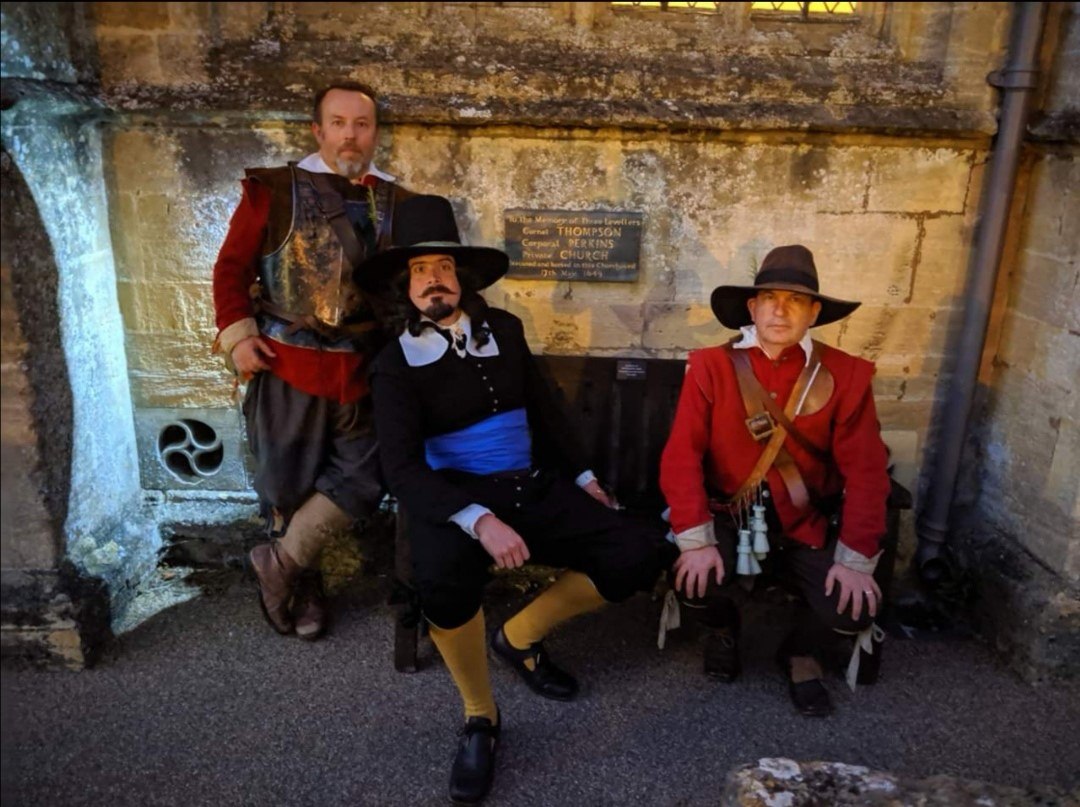
Tim Small, Michael Molcher, and Roly Whear of the Sealed Knot next to the plaque marking the execution of Cornet Thompson, Corporal Perkins, and Private Church
Transcript:
Who were the Levellers?
To their supporters they were common men, soldiers, who asked for a greater say in the affairs of the state. To their detractors they were dangerous radicals, hell-bent on destroying private property and undermining the natural order. To history, they would be martyrs and, to many, an inspiration.
In reality? They were what we today would call a grass roots movement that grew and evolved, and eventually reached such a crescendo that, in the words of the martyred New Model Army Colonel Thomas Rainsborough’s epitaph, they made “king, lords, commons, judges shake”.
The ‘natural order’ had been shaken to its core by the chaos and bloodshed of the first civil war, and those who felt they had paid the highest price for Parliament’s victory – the common soldiers – watched as their paymasters not only did not pay them but negotiated with the King they had defeated.
But the Levellers were not, however, a purely military movement. Soldier and civilian alike were inspired by the words of pamphleteers such as John Lilburne, Richard Overton, William Walwyn, and John Wildman. And they were not a political party in a modern sense, but an idea – one of liberty for all Englishmen, not just the rich and the powerful.
The Agreement of the People, published in 1647, detailed the movement’s demands, which, to our modern ears, seem almost simplistic: a broader franchise, governments elected by popular mandate, religious toleration, and a fair and equitable legal system.
These were all easily summed up by Rainsborough’s reply to the army’s commanders at the seminal moment of the debates in a church in Putney in 1647: “I think that the poorest he that is in England hath a life to live, as the greatest he; and therefore truly, Sir, I think it’s clear, that every man that is to live under a government ought first by his own consent to put himself under that government.”
Amongst the increasingly resentful soldiers of the New Model Army this notion found fertile soil and, as expected, this caused profound panic in their commanders. For many soldiers their adherence to the movement was, at least initially, pragmatic – they wanted their arrears of pay, they asked for indemnity for acts committed during the war, they refused to wage war in Ireland.
But whatever its practical beginnings, it soon developed into something wider – a revolutionary moment. The means of Parliament’s victory – the army – was being radicalised and threatened to dash the social order against the rocks of republicanism. At Putney, the arguments of their supposed social superiors were laid bare as reactionary, counter-revolutionary, and exclusionary.
But this revolution was not to be. We meet today in Burford because in this very churchyard, ringleaders of a mutiny at Salisbury were executed on the orders of Sir Thomas Fairfax and his master of horse, Oliver Cromwell. Discipline in the army was restored and the movement lost its momentum. They would never see the world they dreamt of. Thirteen years later, a king would sit on the throne again, attended by Lords and Commons, overseeing a national conformist church.
We now see the Levellers in relief after centuries of radical movements such as the Liberals, the Chartists, the Suffragettes, and the Socialists, many of whom claimed ideological lineage back to this cry for liberty. Even the US Constitution contains the echoes of the Levellers, a century and a half on.
The words I shall speak in a moment from An Agreement of the People represent a moment when the voice of ordinary men was heard, loudly and forcefully. A voice calling for fundamental, radical change. Demanding that the world could be different, could be fairer.
The Levellers may have ultimately fallen, but in the end we live in a world they might at least celebrate, even if they may not recognise it.
From An Agreement of the People:
Having by our late labours and hazards made it appear to the world at how high a rate we value our just freedom, and God having so far owned our cause as to deliver the enemies thereof into our hands, we do now hold ourselves bound in mutual duty to each other to take the best care we can for the future to avoid both the danger of returning into a slavish condition and the chargeable remedy of another war.
For as it cannot be imagined that so many of our countrymen would have opposed us in this quarrel if they had understood their own good, so may we safely promise to ourselves that when our common rights and liberties shall be cleared, their endeavours will be disappointed that seek to make themselves our masters.
Since therefore our former oppressions and scarce-yet-ended troubles have been occasioned either by want of frequent national meetings in council or by rendering those meetings ineffectual, we are fully agreed and resolved to provide that hereafter our representatives be neither left to an uncertainty for the time, nor made useless to the ends for which they are intended. In order whereunto we declare:
That the power of this and all future representatives of this nation is inferior only to theirs who choose them, and doth extend, without the consent or concurrence of any other person or persons, to the enacting, altering, and repealing of laws; to the erecting and abolishing of offices and courts; to the appointing, removing, and calling to account magistrates and officers of all degrees; to the making war and peace; to the treating with foreign states; and generally, to whatsoever is not expressly or impliedly reserved by the represented to themselves.
Which are as follows:
1. That matters of religion and the ways of God’s worship are not at all entrusted by us to any human power, because therein we cannot remit or exceed a tittle of what our consciences dictate to be the mind of God, without wilful sin. Nevertheless the public way of instructing the nation — so it be not compulsive — is referred to their discretion.
2. That the matter of impressing and constraining any of us to serve in the wars is against our freedom; and therefore we do not allow it in our representatives; the rather, because money (the sinews of war) being always at their disposal, they can never want numbers of men apt enough to engage in any just cause.
3. That after the dissolution of this present parliament, no person be at any time questioned for anything said or done in reference to the late public differences, otherwise than in execution of the judgements of the present representatives (or House of Commons).
4. That in all laws made or to be made, every person may be bound alike; and that no tenure, estate, charter, degree, birth, or place do confer any exemption from the ordinary course of legal proceedings whereunto others are subjected.
5. That as the laws ought to be equal, so they must be good and not evidently destructive to the safety and well-being of the people.
These things we declare to be our native rights; and therefore are agreed and resolved to maintain them with our utmost possibilities against all opposition whatsoever: being compelled thereunto, not only by the examples of our ancestors — whose blood was often spent in vain for the recovery of their freedoms, suffering themselves through fraudulent accommodations to be still deluded of the fruit of their victories — but also by our own woeful experience, who having long expected and dearly earned the establishment of these certain rules of government, are yet made to depend for the settlement of our peace and freedom upon him that intended our bondage and brought a cruel war upon us.
We desire you may understand the reason of our extracting some principles of common freedom out of those many things proposed to you in the Case of the army truly stated and drawing them up into the form of an agreement. It’s chiefly because for these things we first engaged against the king. He would not permit the people’s representatives to provide for the nation’s safety — by disposing of the militia, and other ways, according to their trust — but raised a war against them; and we engaged for the defence of that power and right of the people in their representatives. Therefore these things in the agreement, the people are to claim as their native right and price of their blood, which you are obliged absolutely to procure for them.
And these being the foundations of freedom, it is necessary that they should be settled unalterably, which can be by no means but this agreement with the people.